France's Costly Bet on Public Order: 70,000 Officers Deployed Amid Economic Turmoil
The French state has mobilized a massive security force to manage a second wave of protests, a move that signals significant fiscal and logistical pressure on the government ahead of next year's election.
By Yuna Fletcher ·
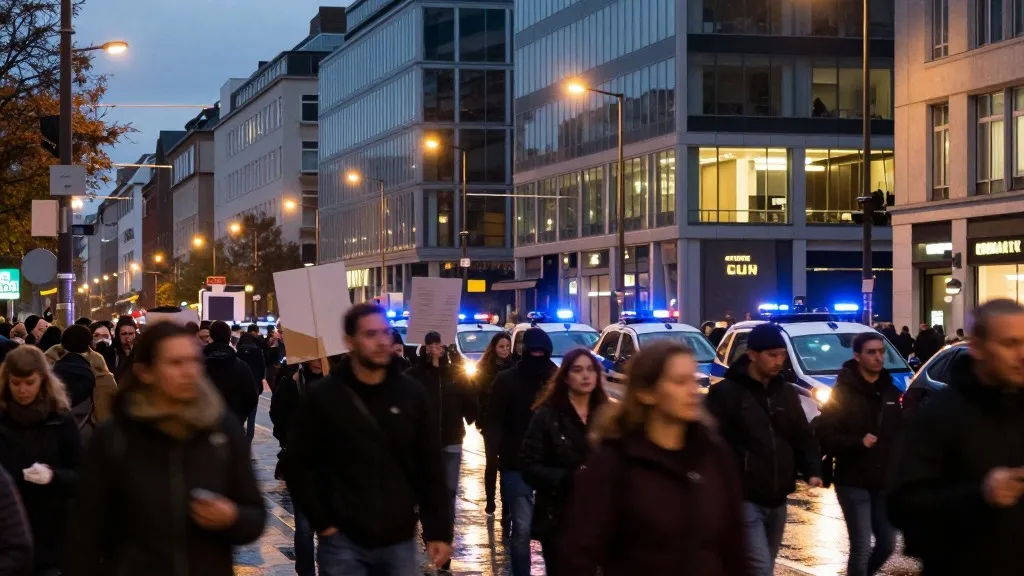
France has committed a substantial portion of its security budget to the streets, deploying over 70,000 officers nationwide as a second wave of mass demonstrations begins.
The mobilization represents a significant escalation in resource allocation, driven by the government's determination to avoid a repeat of the events on October 17. That date saw largely peaceful protests turn into widespread unrest, with thousands of businesses damaged and more than 2,000 people taken into custody. Interior Minister Laurent Nunez confirmed that officer numbers were up by 20 percent compared to the previous weekend. The elite RAID unit was also integrated into the broader operation, supporting other police efforts rather than focusing solely on crowd control. This strategic shift suggests a desire for a more visible, yet potentially less confrontational, presence in the lead-up to the next major demonstration.
The financial and social backdrop for these protests is increasingly tense. Demonstrators are targeting worsening conditions in the education sector and the rising cost of living, issues that resonate strongly with the middle class and public sector workers. The unrest began in mid-September when high school students blockaded schools over dilapidated infrastructure and teacher shortages. By last Saturday, more than half a million people had taken to the streets. This persistent pressure has forced President Emmanuel Macron to engage directly with student representatives for the first time since the movement started, promising additional teachers and a significant overhaul of the Parcoursup university admission system. However, student leaders remain skeptical, stating they will continue mobilizing until concrete actions are presented.
The economic impact of the demonstrations is already visible in the capital. In central Paris, many businesses shuttered early, and shop windows were covered with protective panels. Some retailers hired private security firms to guard their premises, adding to their operational costs. To mitigate potential damage, at least 24 metro stations were closed at the request of the police prefecture. Major cultural institutions, including the Louvre and the Musee d'Orsay, closed their doors for the day. The Art Basel Paris event also cancelled its weekend programme, signaling a cautious approach from the arts and culture market in the face of civic uncertainty.
Logistical challenges have complicated the protest dynamics. Local authorities restricted the Paris march to a specific route along the Boulevards des Marechaux, from Porte d'Italie to Porte de Vincennes. This decision came after an originally negotiated central itinerary was banned, and protests organized by non-union groups were also prohibited. The last-minute changes frustrated participants. Emma, a protester and podcaster, described the tactic as an attempt to drain the movement's energy. Monica, a retired public education worker, noted that the routing gave the impression that authorities wanted to make the movement invisible. Both refused to provide their surnames. The marchers, who included students, teachers, ecologists, nurses, and union representatives, maintained a generally peaceful tone, chanting slogans that ranged from witty quips to calls for President Macron's resignation.
Outside of Paris, the security strategy has yielded mixed results. By early Saturday afternoon, police reported arresting at least 135 people nationwide and seizing various weapons, while acknowledging the overall situation remained calm. However, tensions flared in Lyon, where police fired tear gas to disperse approximately 150 demonstrators. In other cities, including Montpellier, Rouen, and Nice, protests were banned in downtown areas. A union march in Marseille was authorized but under strict conditions. The Yellow Vest movement has also announced its own protest for October 31, indicating that the cycle of demonstrations is likely to continue.
The political implications of this unrest are significant, occurring roughly six months before a pivotal presidential election. President Macron is barred from seeking a third consecutive term and is scheduled to leave office in 2027. In recent polls, Marine Le Pen leads by a wide margin, campaigning heavily on a platform of restoring law and order. This position has gained traction as the government struggles to contain the social unrest. In Orleans, thousands of people shouted anti-fascist slogans while the National Rally held a party congress to mark the start of its campaign. Authorities expected between 20,000 and 30,000 people to join a counter-demonstration, highlighting the growing polarization in the country.
The next few weeks will be critical for the French government. The immediate task is to manage the ongoing protests while delivering on the promises made to student leaders. The cost of maintaining such a large security presence, combined with the economic disruption caused by business closures and transport shutdowns, will likely weigh on the national budget. As the presidential election campaign intensifies, the ability of the government to balance fiscal responsibility with social appeasement will be closely watched by markets and voters alike. The outcome of these negotiations could determine whether the unrest subsides or escalates into a more prolonged period of economic and political instability.
Source: Al Jazeera
More Business · World news · Consumer Watch · Report a business · Got a Story?