Crowds Flood French Streets as School Crisis Deepens
Massive demonstrations across France highlight growing tension between students, parents, and the government over education standards and policing tactics.
By Yuna Fletcher ·
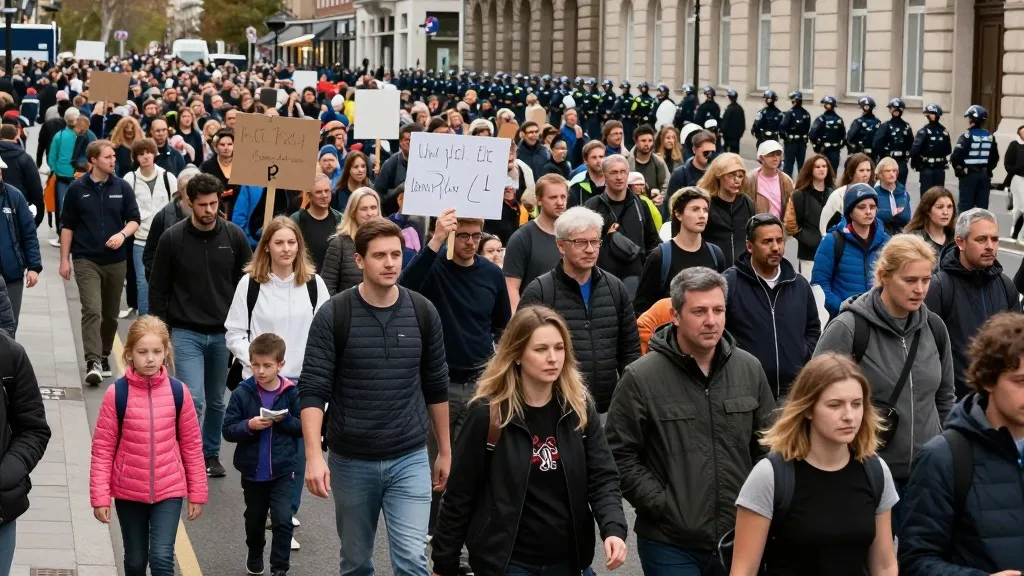
A significant rupture in French society is unfolding as hundreds of thousands of citizens took to the streets this Saturday. The demonstrations, which were largely peaceful, centered on the demands of high school students for better educational infrastructure and more teaching staff. This mass mobilization places President Emmanuel Macron at the center of a widening social and political crisis during the final months of his term. The core conflict involves a youth movement that has expanded beyond the schools, drawing in trade unions, teachers, and parents who are frustrated by what they perceive as a lack of political will and heavy-handed law enforcement.
The scale of the mobilization is evident in the official figures released by the state. Government estimates indicate that at least 400,000 people marched nationwide. However, trade unions argue the turnout was significantly higher, placing the total at double that number. In Paris alone, authorities counted at least 110,000 participants moving along the eastern edge of the city. To manage the crowds and potential unrest, the state deployed more than 70,000 police officers. Precautionary measures included boarding up shops and closing many museums, a response driven by fears of a repeat from the previous weekend. That earlier protest saw one of the most violent days of unrest in recent years, resulting in burned public buildings, hundreds of looted shops, and at least 2,700 arrests.
The participants in these marches represent a broad cross-section of the population, united by specific grievances. In Paris, the atmosphere remained relaxed for much of the afternoon, with brass bands playing and families, including children and grandchildren, joining the crowd. Banners carried by marchers displayed messages such as "Oppression breeds rebellion" and "The right to protest." The crowd included Nadège, a 43-year-old communications worker who was teargassed during the previous weekend's events. She stated that she returned to the streets to support those brave enough to demonstrate, noting that people are now afraid but that protesting remains a legal right. A 21-year-old student from a blockaded Paris science faculty described the current situation as an authoritarian regime attempting to suppress democratic rights.
Despite the generally peaceful tone, tensions escalated at specific points. At Porte de Vincennes on the eastern edge of Paris, groups of masked men dressed in black, who did not appear to be part of the main peaceful march, threw glass bottles and stones at police. Officers responded with teargas, water cannon, and stun grenades. A bin was set alight, and fireworks were launched toward the police line. Similar clashes occurred in other major cities. Teargas was used in Lyon, Lille, Montpellier, Nantes, and Toulouse to keep protesters away from city centers. In Marseille, bin fires were lit amid confrontations. The interior minister, Laurent Nunez, reported that 135 people had been arrested across France. He also noted that various items were confiscated, including metal balls, lead pellets, fireworks, slingshots, steel balls, improvised weapons, a katana sword, and airsoft weapons.
The roots of this crisis trace back to mid-September, when students aged 15 to 18 began protesting staff shortages, crumbling buildings, and a lack of basic furniture like chairs in overcrowded classrooms. What started as a student issue has grown into one of the largest youth movements in years. Police investigations are currently underway after reports that some children and protesters were injured or maimed by explosive police weaponry. The movement has drawn comparisons to the gilets jaunes protests of 2018 and 2019, with some demonstrators wearing yellow vests. Jérôme Rodrigues, a key figure from that earlier movement, stated that the government is afraid and is pushing demonstrators to the edges of cities. He predicted that demonstrations would likely continue every weekend.
The stakes for the government are high, as the crisis challenges Macron's authority and policy approach. Anger has been directed at the president for banning non-union demonstrations deemed illegitimate and for keeping protesters away from central areas. In Orléans, thousands marched against a congress held by Marine Le Pen's National Rally party. The crowd shouted slogans such as "Macron, resign" and "Le Pen in prison." Le Pen is currently a frontrunner in next year's presidential election, adding a layer of political complexity to the ongoing unrest. As the government struggles to find political solutions, the marchers remain determined to defend their right to protest in the street.
The situation continues to evolve as the movement gains momentum. Participants like Pierre, a 60-year-old retired banking consultant, cited a complete refusal by the government to listen to public demands. Jesse, a 40-year-old charity worker, described preparing carefully for the march by wearing old clothes in case of teargas or tears. The combination of educational demands and broader social frustrations has created a powerful coalition that shows no signs of dissipating. With the government facing a difficult balance between maintaining order and addressing the core grievances, the coming weekends are expected to bring further mobilization.
Source: The Guardian