Moon, Mars, and Jupiter align for clear sky viewing
An astronomical conjunction on November 23 will place three bright objects within a small area of the evening sky.
By Julian Kobayashi ·
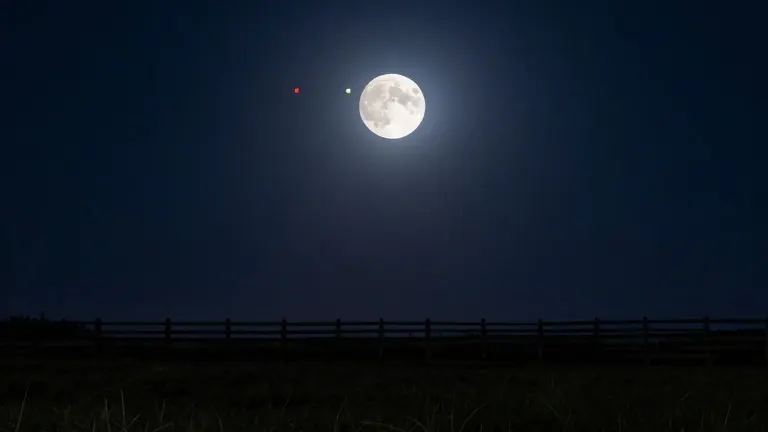
Skywatchers across the country will get an unusually clear look at three major celestial objects in the coming weeks. On November 23, the Moon, Mars, and Jupiter will form a tight grouping in the sky. This event allows observers to see a large portion of the solar system in a single field of view without telescopes.
The alignment offers a rare visual opportunity for casual astronomers. The Moon will pass near the two planets, creating what astronomers call a conjunction. This configuration places the bright, cratered surface of the Moon in close proximity to the reddish hue of Mars and the steady glow of Jupiter. Viewers can identify these objects by their distinct colors and brightness levels against the dark background of space.
The event serves as a practical introduction to naked-eye astronomy. The Moon acts as a navigational tool for locating the two planets. Once observers find the Moon in the evening sky, they can scan the surrounding area to spot Mars and Jupiter. The proximity of these objects makes them easier to find than they would be if they were scattered across different parts of the horizon. This setup simplifies the process of identifying celestial bodies for beginners and experienced stargazers alike.
The timing of this alignment coincides with the fall observing season. Cooler temperatures and clearer skies often accompany this time of year, making outdoor observation more comfortable. The low angle of the Sun in the autumn months also helps distinguish bright planets from the glare of the setting daylight. Conditions during the week of November 23 are expected to be favorable for viewing from both urban and rural locations, provided cloud cover is minimal.
This astronomical event is part of a recurring cycle in the solar system. The relative positions of the Earth, Moon, Mars, and Jupiter change predictably over time. While this specific tight grouping is infrequent, similar conjunctions occur throughout the calendar. Astronomers track these movements to plan optimal viewing dates and to share information with the public. The November 23 event is one of several key dates that skywatchers mark in their calendars for the year.
No special equipment is required to witness the alignment. The naked eye can detect the Moon, Mars, and Jupiter when they are this close to one another. Binoculars or small telescopes can enhance the viewing experience by revealing surface details on the Moon and the cloud bands on Jupiter. The event provides a tangible connection to the mechanics of the solar system, demonstrating how different bodies move in their orbits around the Sun.
The grouping will be visible in the western sky after sunset on November 23. Observers should look toward the horizon shortly after dusk to catch the best view. As the night progresses, the objects will set in the west, limiting the window for observation to the early evening hours. Local weather conditions will determine the clarity of the view, but the geometric alignment guarantees the presence of these three bodies in close proximity.
Source: Cascade PBS