Lunar Water Supply: Harvard Researchers Limit Moon Cities to 10,000 People
New analysis in Frontiers in Space Technologies argues that available lunar water reserves cannot sustain million-person settlements for more than a century.
By Yuna Fletcher ·
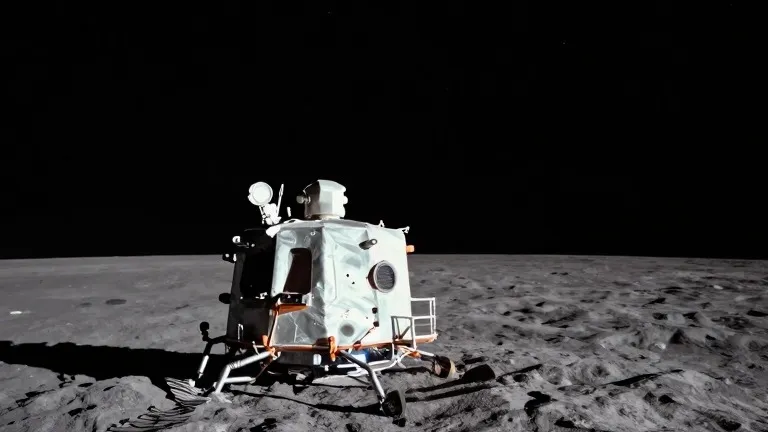
SpaceX CEO Elon Musk declared in February that his company would build a self-growing city on the moon within ten years, while Blue Origin CEO Jeff Bezos predicted millions of people would live in space by 2045. New research challenges the feasibility of these large-scale plans due to limited water resources.
Martin Elvis, a senior astrophysicist at Harvard University's Smithsonian Astrophysical Observatory, and Jonathan McDowell, an honorary professor at the Durham University Space Research Centre, published a paper in Frontiers in Space Technologies. They analyzed whether the moon can support power and water demands for large populations. Power generation appears sufficient, with solar and nuclear sources capable of sustaining one million residents.
The water situation presents a stricter limit. Current estimates suggest approximately one billion tonnes of water exist in permanently shadowed regions at the lunar poles. Assuming a 98 percent recycling rate, similar to the International Space Station, this supply would support one million people for only about 100 years. Elvis described the total volume as a small lake, comparing it to an aquarium the size of Central Park filled until the Statue of Liberty is just underwater.
A smaller settlement would remain sustainable for centuries. The researchers calculated that a town of 10,000 people could rely on the estimated water reserves for a much longer period. McDowell noted that covering the moon with cities requires transporting water to the surface, as it is not currently accessible in large quantities.
The initial estimate of one billion tonnes may be generous. Elvis suggested the actual amount could be 20 or 30 times smaller, with only one-third to one-half of existing water being recoverable. If the available amount is roughly one percent of the original figure, the 100-year supply for one million people shrinks to a single year.
Gordon Osinski, a professor of planetary geology at Western University, highlighted uncertainties in satellite measurements. He stated that the water likely exists but needs ground confirmation. He compared the potential water source to Arctic permafrost, where sub-millimetre ice crystals are mixed into soil, making extraction difficult.
McDowell emphasized that the findings should encourage practical efforts rather than discourage them. He stated that the truth is never negative, and that attempting projects that are not going to work is the negative outcome.
Source: CBC News